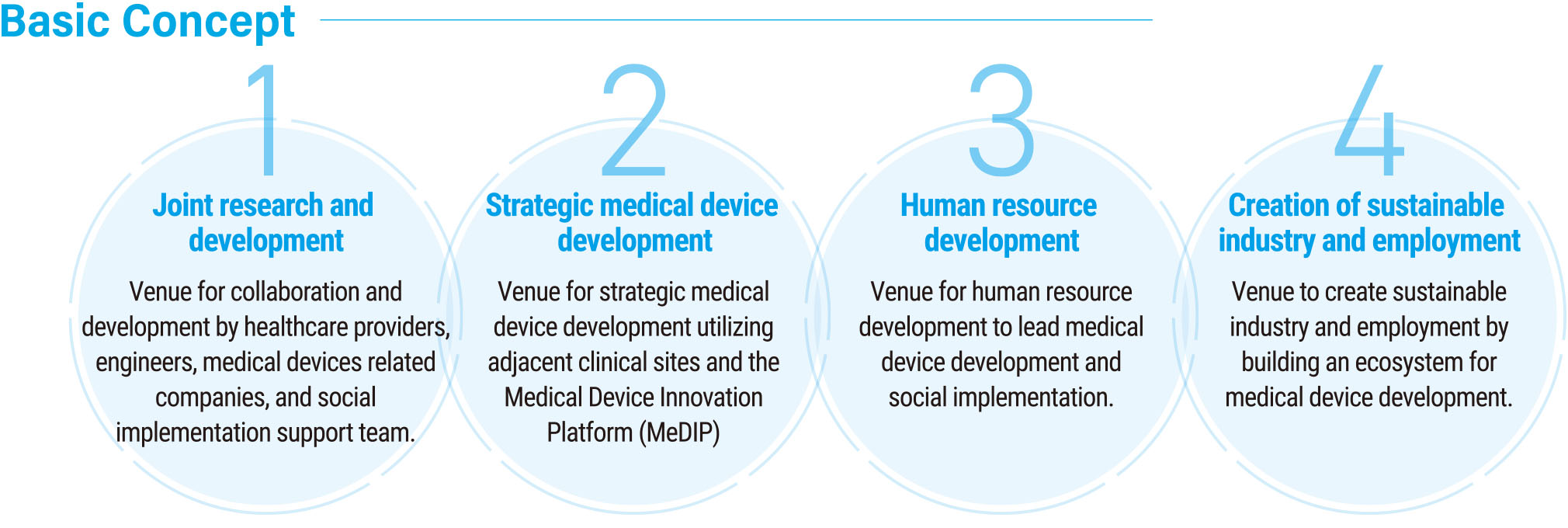
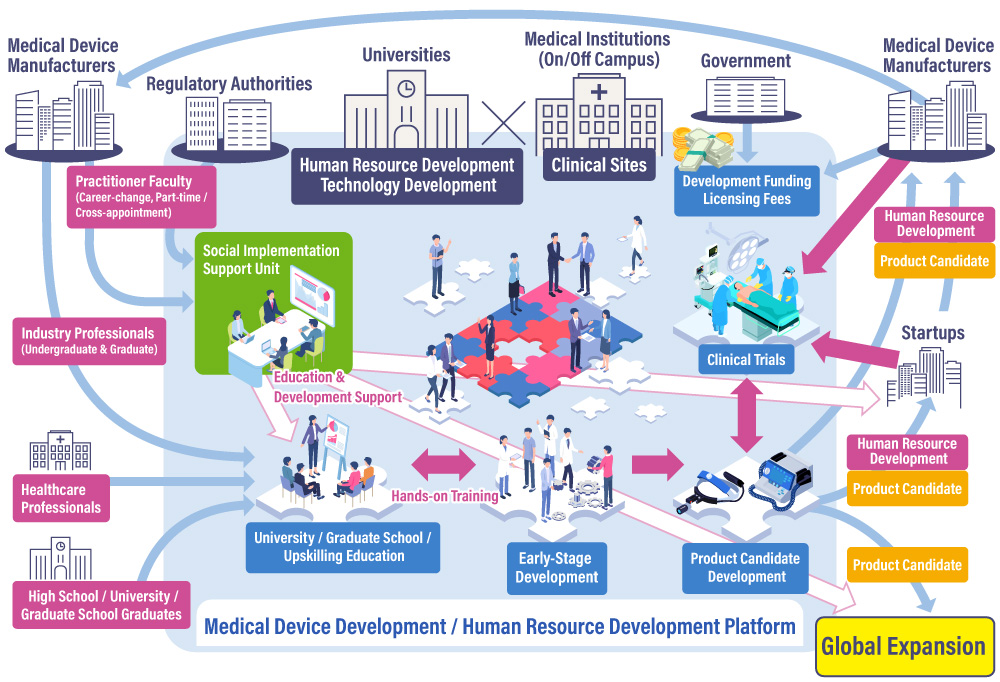
Kobe University is striving to build a Global–Local Hub that will serve as a driving force in Japan’s medical device development ecosystem. Leveraging Kobe’s strong regional foundation in healthcare, research, and innovation, the University seeks to connect knowledge, talent, and technologies from Japan and around the world, accelerating the development and real-world implementation of innovative medical devices.
The hub offers startups, small and medium-sized enterprises, and academic researchers comprehensive, hands-on support throughout the medical device development process. This support covers everything from identifying unmet clinical needs and turning innovative ideas into technologies to prototyping, validation, commercialization, and global expansion. The hub also uses the medical device development process as an opportunity to develop talent. Through the Graduate School of Medicine’s Medical Device Engineering Program, the Faculty of Medicine’s Department of Medical Device Engineering, and the “Medical Device Producer (MDP) Training Program,” an upskilling program for working professionals, the University is committed to continuously nurturing the next generation of medical device developers and development support professionals.
The hub is also committed to addressing unmet medical needs that are often overlooked due to limited commercial viability, particularly in areas such as rare diseases. It aims to develop innovative medical devices that can make a meaningful impact on society.
By supporting both the global expansion (Outbound) of medical devices developed in Japan and the entry of overseas startups into the Japanese market (Inbound), the hub is building a sustainable, open ecosystem that connects Japan with the rest of the world. As a Global–Local Hub that bridges global innovation and local needs, Kobe University aims to advance the medical device industry and help address healthcare challenges both in Japan and around the world.
* Following the curriculum revision in FY2026, the program was renamed the “Medical Device Product Manager (MDPM) Development Program.”
Advancing Human Resource Development and Medical Device Innovation through the integration of clinical practice, education, and collaboration with external partners
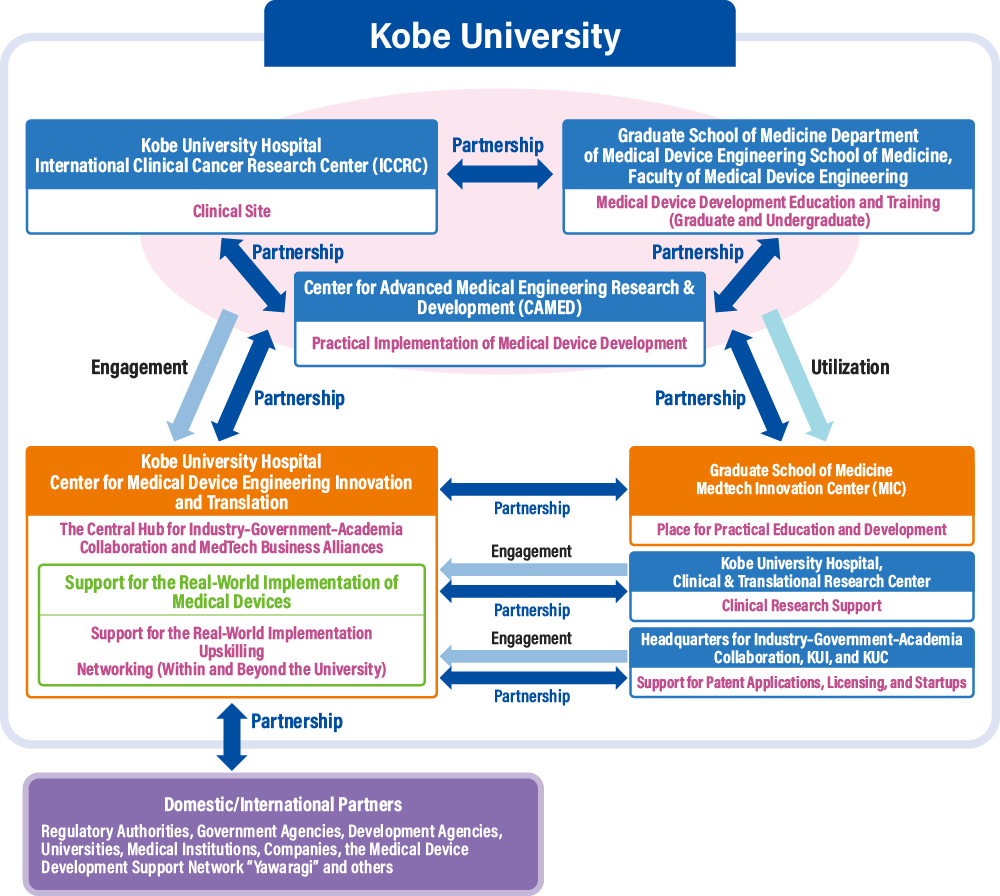
Kobe University is advancing the development and real-world implementation of innovative medical devices while nurturing the next generation of medical device innovators. This is achieved through close collaboration between two clinical settings—the Kobe University Hospital and Kobe University International Clinical Cancer Research Center, and on-campus organizations that provide a range of capabilities, including talent development, hands-on medical device development, and support for real-world implementation.
At the heart of this initiative is the Medical Device Social Implementation Support Unit at the Center for Medical Device Engineering Innovation and Translation, at Kobe University Hospital. The Unit brings together experts from across the University in project management, marketing, intellectual property, regulatory affairs, reimbursement, business development, and other fields to form multidisciplinary teams. In collaboration with Kobe University Innovation (KUI) and Kobe University Capital (KUC), the Unit provides comprehensive, hands-on support to startups, small and medium-sized enterprises, and academic researchers. This support covers the entire process, from identifying unmet clinical needs and developing medical devices to commercialization and global expansion.
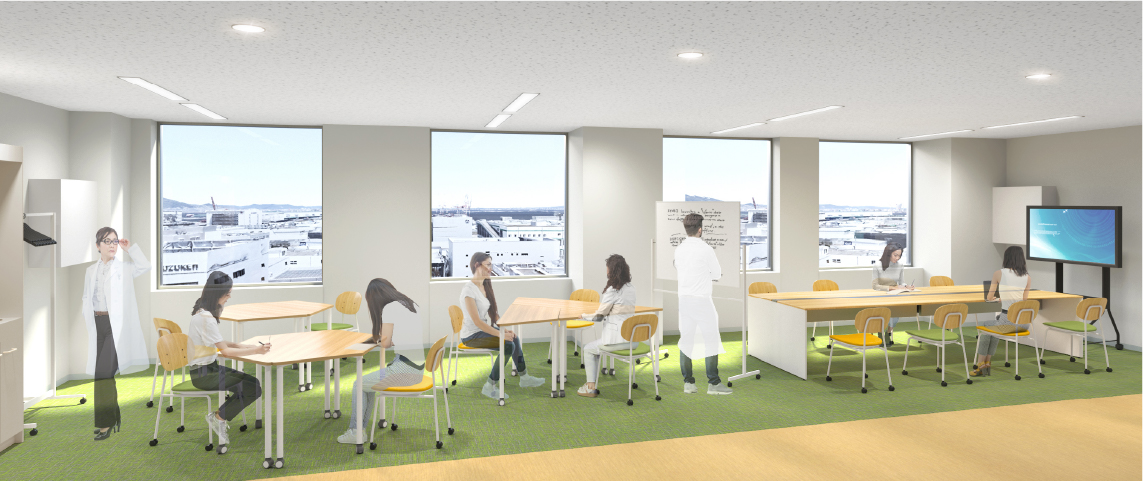
One of the hub’s key facilities, the Medtech Innovation Center (MIC), provides a collaborative space where industry, government, academia, and healthcare professionals come together to turn innovative ideas into practical solutions. Equipped with a wide range of prototyping tools and testing environments, MIC supports rapid prototyping and validation from the early stages of medical device development. With support from engineering researchers and clinical engineering experts, MIC helps accelerate development through an iterative process of evaluation and refinement, ensuring that innovations meet the needs of real-world clinical settings.
The hub also works closely with the Medical Device Integrated Development and Innovation Platform (MeDIP), which provides facilities for preclinical evaluation using large animals. It also collaborates with medical institutions such as the Foundation for Biomedical Research and Innovation at Kobe, Kobe City Medical Center General Hospital, Hyogo Prefectural Kobe Children’s Hospital, and a broad network of industry partners. Through these collaborations, the hub connects industry, government, academia, and healthcare organizations as part of the Kobe Biomedical Innovation Cluster. In addition, the hub maintains ongoing partnerships with medical device development support organizations, including the Osaka Chamber of Commerce and Industry, the Fukushima Medical Device Industry Promotion Organization, and the Medical Device Development Collaboration Network “Yawaragi.”
By strengthening partnerships both in Japan and overseas—with universities, venture capital firms, incubators, accelerators, and other organizations—the hub is helping to build a global ecosystem that supports the development, commercialization, and real-world implementation of innovative medical devices.
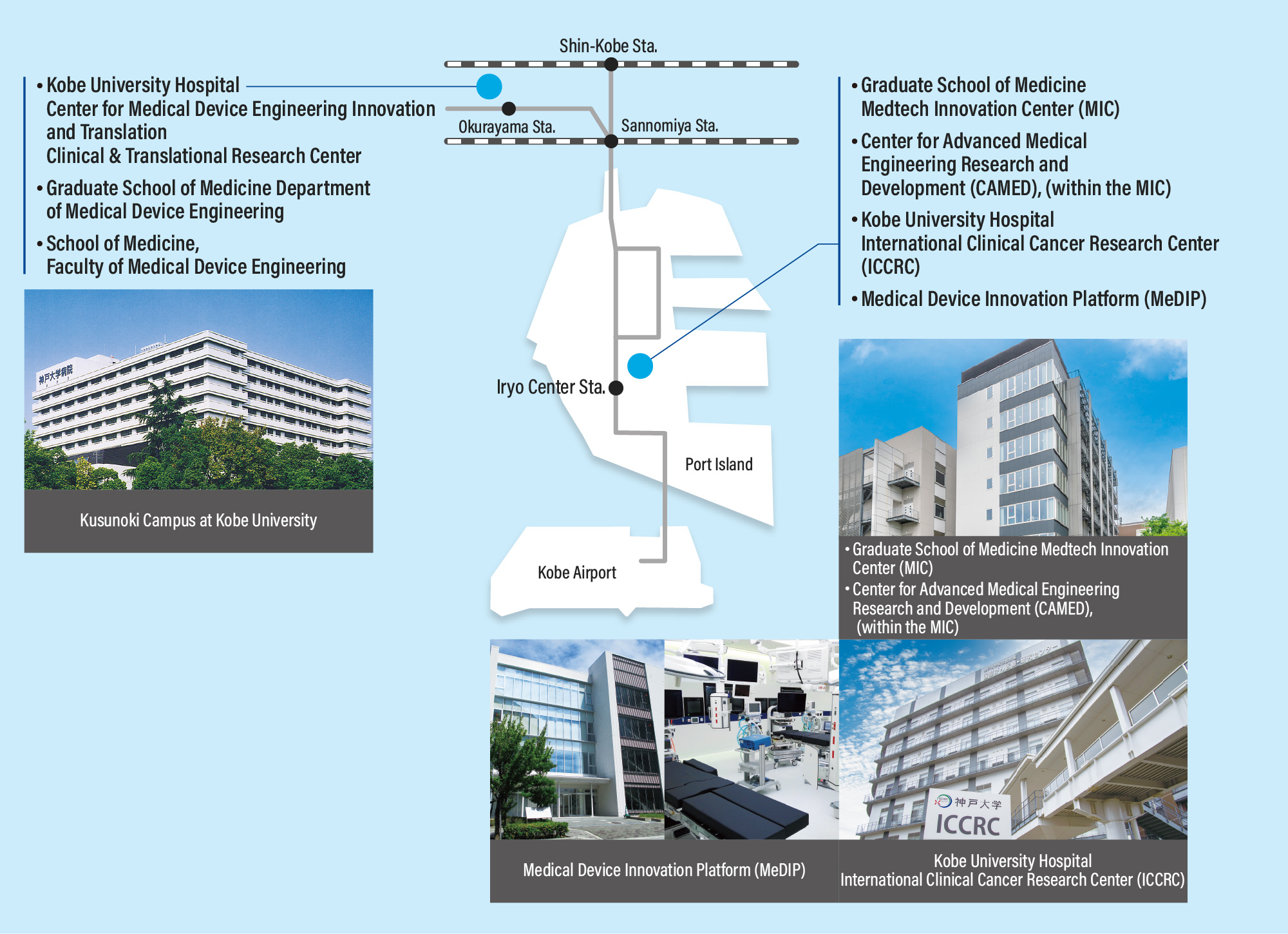
At the Medtech Innovation Center, we provide a platform where industry, government, academia, and healthcare professionals collaborate to put early-stage medical device development into practice. Our mission is twofold: to promote fast-track medical device development and to foster the next generation of talent through hands-on programs that use real-world projects as teaching material. The Center features state-of-the-art engineering and medical device laboratories, a shared workshop, and rental labs available for corporate tenants. It also includes collaborative spaces designed to encourage interaction among diverse stakeholders. By combining these resources with deep expertise, the Center strives to serve as a hub of integrated knowledge, drive the ongoing creation of innovative medical devices, and nurture creative talent, thereby helping to revitalize the medical device industry.