Human Resource Development

2026 Academic Year

Now Accepting Applications:
1st Medical Device Product Manager (MDPM) Development Program - Starting in October, 2026

The Entry Course of the Medical Device Producer (MDP) Development Program, an upskilling program for working professionals launched in FY2017, has produced approximately 200 participants to date. Beginning in October 2026, the program will be relaunched as the Medical Device Product Manager (MDPM) Development Program, featuring a revamped course structure and curriculum to further strengthen the development of professionals in the medical device field.

The MDPM Development Program is designed for corporate professionals, healthcare professionals, researchers, startup professionals, and others. It provides a systematic approach to the concepts and knowledge required throughout the medical device development process, from identifying clinical needs to commercialization.

The program consists of the following three course categories:
・Innovation Process Course
・Operations Process Course
・Medical Device Hands-on Training Course


Participants can select and take the courses that best meet their individual needs and objectives. By freely combining courses across the three categories, participants can efficiently acquire the practical knowledge and skills needed for medical device development.

○ Those who wish to learn the fundamentals of medical device development in a systematic way are encouraged to begin with the Innovation Process Course. This course develops the critical thinking and creativity that form the foundation for all courses in the program.

○ Those who already have a basic knowledge of medical device development and wish to deepen their expertise in specific areas, such as marketing, intellectual property, regulatory affairs, reimbursement and insurance coverage, and quality management, may take individual classes within the Operations Process Course.

○ Those who wish to gain hands-on experience with actual medical devices and develop the practical skills needed for medical device development from both medical and engineering perspectives are encouraged to take the Medical Device Hands-on Training Course.

Application Guidelines for the 1st MDPM Development Program

1.Eligibility

Corporate professionals, healthcare professionals, researchers, startup professionals, and others interested in pursuing medical device development.
Applicants may come from any professional or academic background. Participants do not need to have a science / STEM background.

2.Application Period

Tue., September 1, 2026 – Tue., October 13, 2026, by 5:00 p.m.
*This application period is open only for courses scheduled to be offered during FY2026, among the courses comprising the full curriculum. Please apply for all courses you wish to take during the application period.
*Additional applications for courses scheduled to be offered from April through September 2027 are planned for around February 2027.
*Courses may close for applications before the end of the application period if they reach capacity.
*Courses may be canceled if the number of applicants does not meet the minimum required for the course to be offered.

3.Course Details

For details on the curriculum, course fees, and other information, please see the Application Guidelines and Course Curriculum.


On September 7, courses for which archived videos are available were added to the Application Guidelines and Course Curriculum.

4.To Apply

5.Others

① Schedule

Program Period: Friday, October 23, 2026 - End of September 2027 (planned)
Make-up Period: Friday, October 23, 2026 - End of September 2028

○ Please complete the courses you have registered for during the scheduled course period whenever possible.

○ The following options are available during the make-up period:

 ・If you are unable to attend a course due to unforeseen circumstances after paying the course fee, you may attend the same course when it is offered during the make-up period. (See “Future Course Schedule.”)

 ・You may view archived videos of the courses you have registered for, provided that the courses are eligible for archival viewing (*).

  *Only courses conducted in a lecture format are eligible for archival viewing. Workshop-format courses are not available for archival viewing. Archive videos may only be viewed by the registered participant. Viewing by anyone other than the registered participant is strictly prohibited.

Schedule for the 1st Program

Application Period
Program Period
Make-up Period
Tuesday, September 1 –
Tuesday, October 13, 2026
October 2026 End of September 2027 End of September 2028
Courses Offered from April to
September 2027
Application Period: Scheduled to open around February 2027
Participants may take the same course
when it is offered in a subsequent term.
* The same course offered during the periods
highlighted in red in the schedule below.

Future Course Schedule

Application PeriodProgram Period / Make-up Period
1st Program
Start from September 2026
October 2026 The end of September 2027 The end of September 2028
2nd Program
Scheduled to open
in February 2027
April 2027 The end of March 2028 The end of March 2029
3rd Program
Scheduled to open
in February 2028
April 2028 The end of March 2029 The end of March 2030

② Certificates of Completion

A Certificate of Completion will be issued upon request for each course completed.
Depending on the course, participants may be required to submit completed assignments or other documentation to demonstrate that they have achieved the learning objectives.

Contact  Kobe University Hospital

Center for Medical Device Engineering Innovation and Translation
MDPM Development Program Office
Tel:078-382-5693 E-mail:kikisou@med.kobe-u.ac.jp
Cultivating Medical Device Producers at Kobe University

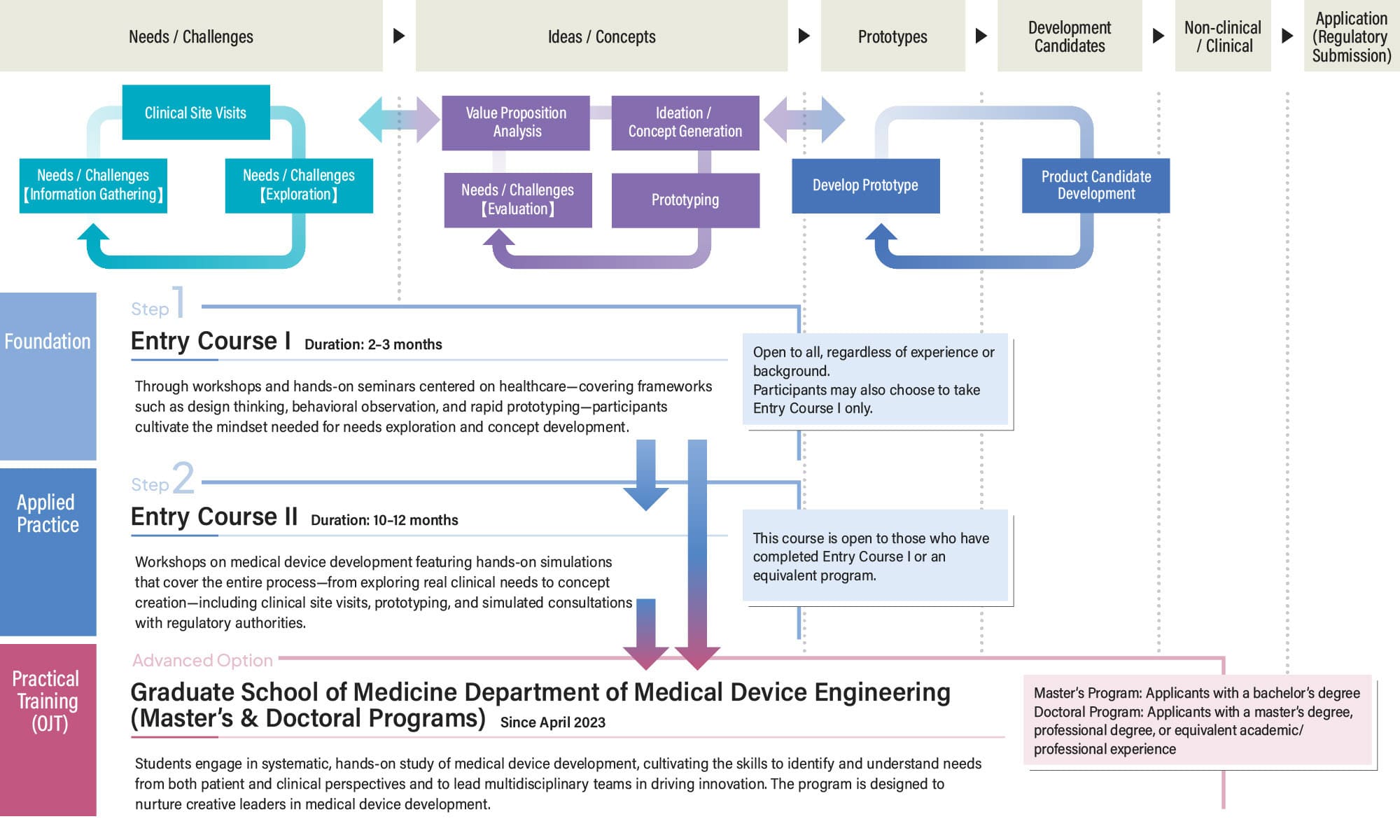
With a mission to “nurture the creative talent who will drive the real-world implementation of innovative medical devices,” Kobe University is cultivating the next generation of medical device innovators through three pillars of education: graduate programs, undergraduate programs, and upskilling programs for working professionals.
Since its launch in FY2017, the “Medical Device Producer (MDP) Training Program” for working professionals has produced approximately 200 participants who have completed the program to date with the knowledge and skills needed to drive medical device innovation (as of July 2026). Building on these educational achievements, Kobe University established the Department of Medical Device Engineering in the Graduate School of Medicine in FY2023, followed by the Department of Medical Device Engineering in the Faculty of Medicine in FY2025 (*). Together, these programs form a comprehensive talent development platform that enables people from diverse backgrounds—including working professionals, students, researchers, and healthcare professionals—to develop their knowledge and skills and advance their careers according to their individual goals and aspirations.
From FY2026, Kobe University will launch the new “Medical Device Product Manager (MDPM) Development Program,” featuring a redesigned course structure and curriculum to further develop highly skilled professionals who can drive medical device innovation.
The MDPM Development Program provides professionals from a wide range of backgrounds—including industry, healthcare, academia, and startups—with hands-on learning opportunities covering the entire medical device development process, from identifying unmet clinical needs to developing commercialization strategies. At the graduate and undergraduate levels, Kobe University cultivates highly specialized professionals who can advance medical device research and development through to real-world implementation, supported by close collaboration between medicine and engineering.
These three educational programs are closely interconnected, providing flexible learning pathways from professional upskilling to undergraduate and graduate education. This enables learners to develop the knowledge and skills that best suit their individual goals and career aspirations.
Kobe University is committed to advancing medical innovation by addressing healthcare challenges through medical device development and continuously nurturing the next generation of professionals who can create new value through collaboration across disciplines.

* In April 2026, the Graduate School of Medicine and the Graduate School of Health Sciences were integrated to establish the Graduate School of Medical Sciences.


Talent Development Program Focused on the Early Stages of Medical Device Development

Medical Device Product Manager (MDPM) Development Program

The redesigned program offers a flexible, modular learning experience tailored to individual needs. The program is organized into three categories covering the medical device development process, from research and development through to market launch: Innovation Process, Operations Process, and Medical Device Hands-on Training. Each category comprises short, focused workshops (WS) and seminars that participants can take individually or combine to suit their professional responsibilities and learning objectives. This flexible approach enables participants to efficiently acquire practical knowledge and skills that they can directly apply to their work.

− Innovation Process Course

In the Innovation Process Course, participants explore the early stages of medical device development, from needs exploration to concept development. By gaining a deeper understanding of the challenges faced by healthcare professionals and patients and identifying the needs behind those challenges, participants develop the critical thinking and creative skills needed to turn real-world insights into innovative medical device ideas.
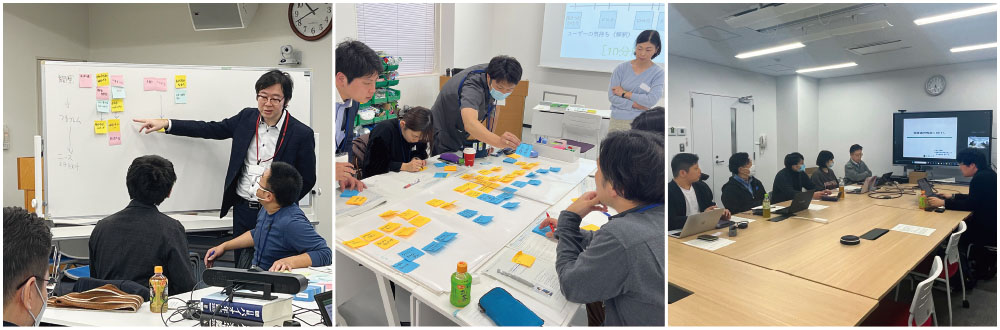
Throughout the course, participants use design thinking methodologies to gain hands-on experience with the full process—from observation and problem identification to articulating needs, developing concepts, and evaluating solutions—through interactive workshops. By engaging in discussions and collaborative activities with participants from diverse backgrounds, they learn to approach challenges from multiple perspectives and gain practical experience in solving problems together.
The course goes beyond generating ideas, participants also learn how to refine clinical needs into viable development opportunities with commercialization potential. Designed for a diverse range of participants—including industry professionals, healthcare professionals, researchers, and students—the program welcomes everyone from those new to medical device development to those seeking to deepen their expertise in advanced development processes. It equips participants with the foundational skills needed to become future leaders of medical device development projects and to serve as a bridge between clinical needs and technological solutions.


− Operations Process Course

The Operations Process Course focuses on the business strategies and development management skills needed to turn innovative concepts into medical devices and bring them into clinical use. Successful medical device development requires more than outstanding technologies and innovative ideas. It also demands strategic planning from multiple perspectives, including marketing, intellectual property, regulatory affairs, reimbursement, and quality management. Through the Development and Commercialization Strategy Workshops and Seminars, participants develop a comprehensive understanding of the medical device development process and gain practical knowledge of marketing, intellectual property, regulatory affairs, reimbursement strategies, and cadaver-based medical device development. The Startup Workshops and Seminars provide essential knowledge needed to launch and manage medical device startups, including the fundamentals of Quality Management Systems (QMS).

− Medical Device Hands-on Training Course

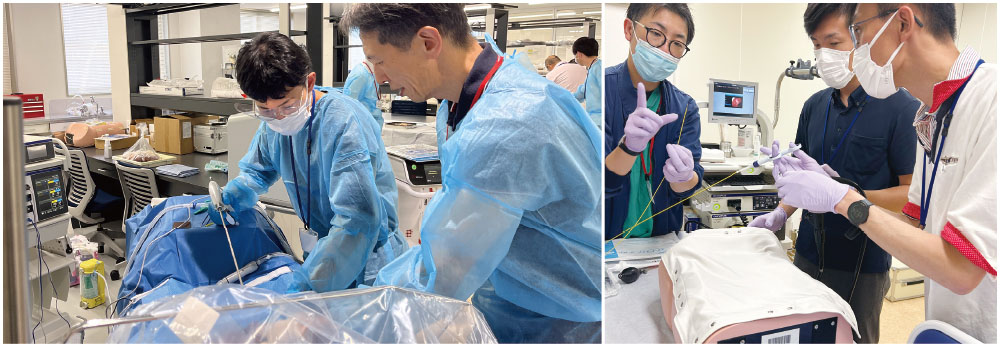
The Medical Device Hands-on Training Course offers an immersive, hands-on learning experience, allowing participants to handle and operate actual medical devices while developing the skills needed to advance medical device development. Using medical devices currently used in clinical settings as learning tools, participants deepen their understanding of the functionality, usability, and safety required in healthcare. In the Reverse Engineering Workshop, participants disassemble medical devices to explore their internal structures, operating principles, and underlying design concepts. Through this process, they gain insights that can help them identify unmet needs and develop new medical device concepts. In the Medical Device Operation Hands-on Course, participants gain firsthand experience using surgical robots, endoscopes, energy-based devices, and other medical technologies. This practical experience gives them a deeper understanding of the challenges faced by healthcare professionals and the user experience in real-world clinical settings. In the Prototyping Workshop, participants learn how to turn their ideas into tangible prototypes using 3D CAD, 3D printing, and machining technologies. Through these hands-on activities, participants develop both medical and engineering perspectives, helping them bridge the two fields and contribute to the development of innovative medical devices.

Graduate School of Medicine Department of Medical Device Engineering / Faculty of Medical Device Engineering

The Medical Device Engineering Program within the Graduate School of Medical Sciences offers a master’s degree program in the Advanced Life and Medical Sciences track and a doctoral degree program in Medical Device Engineering. Students can earn a Master’s or Doctorate in Medical Device Engineering while gaining hands-on experience in medical device development. The Department of Medical Device Engineering in the Faculty of Medicine draws on the strengths of a medical school to provide students with comprehensive, hands-on training in medical device development, grounded in real-world clinical needs. The Medical Device Engineering Program provides an environment where students can turn their research into practical innovations. Graduate students have filed patents and conducted collaborative research with industry partners, resulting in tangible outcomes such as regulatory approval and reimbursement coverage for medical devices developed through the program. These achievements demonstrate how academic research can be translated into real-world medical solutions.